

Global food conglomerate Mars Incorporated is embarking on a rigorous journey to slash its carbon emissions by 50% across its entire value chain by 2030, aiming for net-zero emissions by 2050. A substantial investment of $1 billion over the forthcoming three years has been pledged to expedite this transition. Mars’s current carbon footprint rivals that of Finland thus a reduction of this magnitude equates to eliminating around 15 million tonnes of emissions.
A meticulous breakdown reveals that only 4% of its emissions stem directly from operations, and the remainder is upstream from suppliers and raw materials and downstream including retailing of their products by supermarkets and the emissions released when end consumer cook their product. These emissions are referred to as Scope 3 emissions and the Australian government is looking to make reporting on Scope 3 emissions mandatory from July 1, 2024 for large companies.
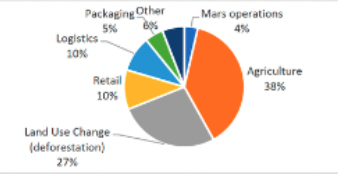
With an ethos proclaiming that “profit and purpose are not enemies”, CEO Poul Weihrauch emphasizes that substantial emission reductions are not only environmentally pivotal but also economically viable and paramount for business longevity. Mars’s Roadmap to Net Zero provides a strategic framework not only for internal use but also as an open-source guide for other businesses to navigate their pathway to net zero, Mars operations 4% Agriculture 38% Land Use Change (deforestation) 27% Retail 10% Logistics 10% Packaging 5% Other 6% emphasizing thorough emissions accounting, prioritizing genuine performance, and incorporating high-quality carbon offsetting.
Tangible strategies include transitioning entirely to renewable energy, reengineering supply chains to eliminate deforestation, amplifying climate-smart agricultural practices, and innovating in areas like low carbon footprint ingredient utilisation and logistic optimisation. Notably, in Australia, Mars has implemented novel practices such as introducing Graphite Energy’s commercial Electric Thermal Energy Storage system and developing recyclable paper-based packaging, illustrating a pragmatic application of their global objectives, and contributing to a tangible impact in their journey towards sustainability.